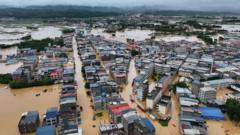
Rising Tensions in el-Obeid Amidst Sudan's Civil War
El-Obeid, a key city in Sudan's ongoing civil war, is experiencing increased drone attacks, leading to fears of a potential massacre. A 27-year-old student, referred to as Sarah for her safety, recounted her ordeal at a fuel station when a drone struck without warning, causing chaos and injuries. 'The station lit up, and then everything went dark,' she described, emphasizing the extent of devastation.
Currently under the control of Sudan's army, el-Obeid, with a population of approximately 500,000, hosts one of the largest military bases in central Sudan. Despite this, the city has been unable to fend off drone strikes from the paramilitary Rapid Support Forces (RSF), which have intensified over the past month.
Drone Strikes and Humanitarian Concerns
According to the violence monitoring group Acled, the city suffered 27 drone strikes in June alone, marking the highest monthly total since the conflict began. UN human rights chief Volker Turk reported at least 45 fatalities and 41 injuries from 15 drone attacks between early and late June. He warned of an unfolding human rights catastrophe, citing siege-like conditions and atrocities such as executions and abductions.
Nathaniel Raymond, from Yale University's Humanitarian Research Lab, highlighted the strategic importance of el-Obeid, lying between RSF-controlled western regions and army-held eastern territories. 'Controlling el-Obeid means controlling the route to Khartoum and Omdurman,' he stated.
A local doctor, overwhelmed by the influx of casualties, shared harrowing accounts of injuries, including a seven-month-old baby who did not survive. 'The situation is terrifying. We leave our homes uncertain of return,' she lamented.
Warnings and Strategic Implications
Amnesty International's Agnès Callamard expressed concerns that el-Obeid might face violence similar to what occurred in el-Fasher, where the RSF seized control following an 18-month siege. However, Raymond noted that el-Obeid currently lacks the ethnic tensions observed in el-Fasher, suggesting a large-scale RSF attack might not be imminent.
Acled's Nohad Eltayeb reported that the RSF has encircled el-Obeid from several directions, yet the army has fortified its positions, maintaining a crucial supply corridor. 'While an RSF attack is likely, a complete takeover seems improbable,' she said.
Drone strikes have largely targeted fuel stations, leading to significant damage and fuel shortages. The city's infrastructure, including its main electrical substation and markets, has also been affected, threatening daily life and potentially causing waterborne diseases due to disrupted water supplies, according to Raymond.
Displacement and Civilian Struggles
El-Obeid hosts about 100,000 displaced individuals from other conflict zones. Many residents, including a humanitarian worker named Ahmed, fear they may need to flee again as the drone strikes continue. 'People are in constant fear, unable to sleep,' Ahmed noted.
Sarah described the pervasive fear among civilians, with many hesitant to leave their homes. 'We say goodbye to our families each time we step out, unsure if we'll return,' she explained.
Source: BBC News