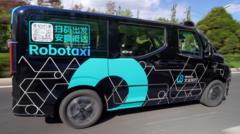
China's Robotaxi Vision Takes Shape
In the Yizhuang district of Beijing, driverless cars have become a familiar presence. Robotaxis navigate the busy streets alongside traditional vehicles, while autonomous delivery vans move efficiently in the designated lanes. This area is one of China's key testing grounds for self-driving technology, where firms like Baidu, WeRide, and Pony.ai operate robotaxi services within specific zones.
Booking a robotaxi is straightforward, requiring just an app. Upon confirmation, the vehicle seamlessly merges into Beijing's bustling traffic, deftly avoiding buses, cyclists, scooters, and pedestrians. Although the technology is still advancing, a major question arises: Can Chinese companies replicate their electric vehicle (EV) success in the international robotaxi sector?
Building on EV Success
China's foray into autonomous driving is supported by its robust EV infrastructure. Unlike Tesla's in-house development approach, China's self-driving industry thrives on a network of companies. Established automakers like BYD, Chery, Geely, and SAIC produce the vehicles, while specialized firms handle the software.
Autonomous vehicles share many components with electric cars, such as batteries, sensors, and chips. These pre-existing supply chains allow for rapid and cost-effective technological development. According to Kyle Chan, a fellow at the Brookings Institution, "China's pace of innovation in the EV industry is unmatched globally, with overlapping tech ecosystems enhancing efficiency."
Government Support and Challenges
Government policies have facilitated the testing of autonomous technology on public roads in several cities. China offers a complex driving environment, providing valuable data for software improvement. Maeve Zhang, WeRide's chief marketing officer, highlights the diversity of road users as a key advantage for data collection.
Nevertheless, global expansion presents challenges. Adverse weather conditions, such as high temperatures in the Middle East or heavy rain in Southeast Asia, can affect battery performance and sensor functionality. Despite these hurdles, companies like QCraft are expanding their autonomous technology to various vehicles, including buses and delivery vans.
Global Competition and Perception
Chinese firms are rapidly expanding internationally, facing competitors like Waymo, the leader in the US market. While some American companies are slower to expand, partnerships with Chinese firms provide access to extensive customer bases, as noted by Tu Le of Sino Auto Insights.
Waymo's experience in customer service and app technology sets a high standard, with some users expressing a preference for its services over Chinese counterparts. In the US, concerns about job displacement due to automation are prevalent, whereas China's policy promotes AI and robotics as solutions to workforce challenges. However, government censorship makes it difficult to gauge public opinion.
Future Prospects and Challenges
China's push for autonomous vehicles aligns with President Xi Jinping's vision of a high-tech, AI-driven economy. Advocates argue that robotaxis could enhance mobility for those unable to drive, potentially lowering costs compared to traditional ride-hailing services.
However, safety concerns persist. Earlier this year, Baidu's Apollo Go service experienced a software glitch, stranding robotaxis in Wuhan and affecting public confidence. Similar issues have occurred globally, with companies like GM halting robotaxi operations due to safety concerns.
Exporting robotaxis presents unique challenges, including regulatory approvals, mapping requirements, and public trust. Moreover, geopolitical tensions could hinder the collection of mapping and location data, posing national security risks in some markets.
Despite these challenges, WeRide observes positive regulatory developments both in China and internationally. For Kyle Chan, robotaxis symbolize China's pursuit of a technologically advanced economy, leveraging strengths in EVs, batteries, and motors to drive growth.
Source: Original Article